CRM & Marketing Automation
The Lead Follow-Up Problem No One Talks About
Your business development team receives an inquiry from a potential client. They call back. The prospect says they're evaluating options and will get back in two weeks. Your team makes a note on a sticky pad or in a WhatsApp message to themselves. Two weeks pass. Nobody follows up. The prospect signs with a competitor who called them three times.
This scenario plays out in security agencies and facility management companies across India every single day. Not because the sales team is incompetent. But because there is no system.
A CRM — Customer Relationship Management — system is that system. And combined with marketing automation, it transforms your business development operation from a reactive, memory-dependent process into a structured, measurable pipeline.
Why B2B Sales in the Security & FM Sector Needs a CRM
Security agency and facility management contracts are not impulse purchases. A corporate client evaluating security vendors goes through a process that can take 30 to 90 days — internal discussions, multiple vendor meetings, site visits, proposal comparisons, budget approvals. During this entire period, the vendor that stays visible, follows up at the right intervals and provides the right information at the right time has a significant advantage.
Without a CRM, managing this process across 20 or 30 active prospects simultaneously is impossible. With a CRM, every prospect's status, every interaction, every follow-up date and every communication is tracked and managed systematically.
What We Set Up For You
We implement a CRM solution appropriate for your business size and budget — not enterprise software that requires a dedicated IT team, but practical, affordable tools that your business development team can actually use from day one.
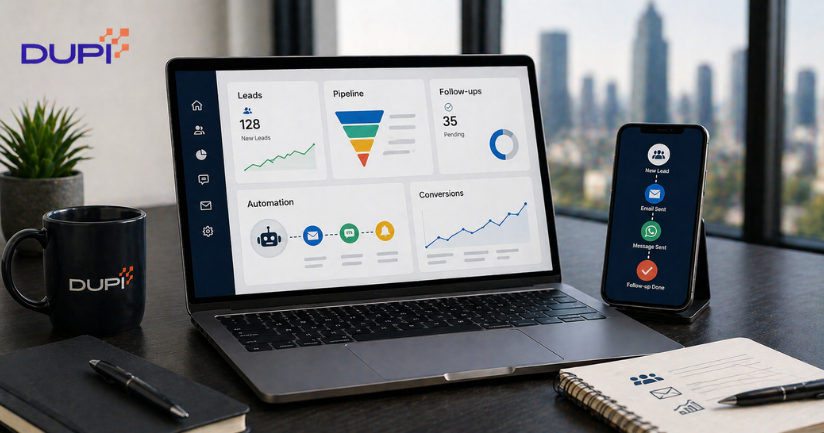
Your CRM will capture every lead from every source — website contact form, GMB inquiry, referral, cold outreach — in a single pipeline view. Every lead is assigned, every follow-up is scheduled and every conversation is logged. Nothing falls through the cracks.
Marketing automation complements your CRM by handling the routine communication touchpoints automatically. When a prospect inquires through your website, they receive an immediate, professional acknowledgement. When a proposal is sent, a follow-up sequence is triggered. When a contract renewal date approaches for an existing client, your team is reminded to initiate the conversation.
Email marketing integration allows you to stay in front of your prospect and client base with relevant content — industry updates, service announcements, seasonal safety advisories — keeping your company top of mind through the long B2B sales cycle.
The Revenue Impact
Companies that implement CRM and marketing automation consistently report shorter sales cycles, higher conversion rates from inquiry to contract and significantly better client retention. For a security agency or FM company where a single client contract can be worth ₹20 lakh to ₹2 crore annually, even a marginal improvement in conversion rate has a substantial revenue impact.
Frequently
Asked Question
CRM — Customer Relationship Management — is a system that organizes, tracks and manages every interaction your business has with potential clients, existing clients and leads across the entire sales and service lifecycle. For security agencies and facility management companies in India, a CRM solves a fundamental operational problem that costs these businesses significant revenue every year — the systematic loss of leads and opportunities due to unstructured follow-up processes. In most PSA and FM companies, business development happens through a combination of phone calls, WhatsApp messages, Excel sheets and personal memory. Inquiries come in through various channels — referrals, website contact forms, GMB calls, cold outreach responses — and are tracked inconsistently or not at all. Follow-up depends on individual team members remembering to call back. Proposal submissions are not tracked systematically. Contract renewal dates are missed. The cumulative revenue impact of these gaps — in a sector where a single client contract can be worth ₹20 lakh to ₹2 crore annually — is substantial. A CRM system eliminates these gaps by creating a single, structured, visible pipeline where every lead, every interaction, every follow-up commitment and every contract status is tracked automatically and made accessible to everyone on the business development team.
Marketing automation is particularly valuable for security agencies and facility management companies because their B2B sales cycles are long — typically 30 to 90 days from first inquiry to contract signing — and involve multiple touchpoints that must be managed consistently across a large number of simultaneous prospects. Marketing automation handles the routine communication touchpoints in this cycle automatically, ensuring that every prospect receives timely, relevant and professional communication without requiring manual effort from the business development team at every step. When a potential client submits an inquiry through your website, marketing automation sends an immediate professional acknowledgement — establishing responsiveness before your team has even seen the inquiry. When a proposal is sent, an automated follow-up sequence ensures the prospect hears from you at appropriate intervals without your team having to manually track and schedule each follow-up. When a contract renewal date approaches for an existing client, the system automatically alerts your account management team and triggers a client communication sequence. When a prospect who did not convert initially visits your website again months later, automation can trigger a re-engagement communication. For FM companies managing relationships with dozens of corporate clients and hundreds of prospects simultaneously, marketing automation transforms what would otherwise be an unmanageable communication workload into a systematic, consistent and measurable process.
The CRM features most important for security agency business development in India reflect the specific characteristics of how PSA companies acquire and retain clients. Lead source tracking is essential because security agencies typically receive inquiries from multiple channels — GMB calls, website forms, referrals, tender responses, direct outreach — and understanding which channels generate the highest quality leads informs budget allocation decisions. Geographic pipeline visibility is important because security agencies operate across multiple licensed states, and the business development pipeline must be viewable by region to align with PSARA licensing boundaries and deployment capacity. Contract value and renewal date tracking allows the business development team to prioritise high-value prospects and ensure no renewal opportunity is missed. Document management for storing proposals, agreements, PSARA licence copies and client-specific service level agreements keeps all critical documentation accessible and organised. Activity logging for calls, meetings, site visits and email communications creates a complete interaction history for every prospect and client that can be referenced by any team member. Mobile accessibility is critical because business development executives in security agencies are frequently in the field — visiting client sites, attending meetings, conducting site surveys — and need CRM access from their smartphones. Integration with WhatsApp Business is increasingly important in the Indian market because a significant proportion of business communication in the PSA sector happens through WhatsApp rather than formal email.
Email marketing integration supports client retention for facility management companies by creating a consistent, professional communication channel that keeps your company visible and relevant to existing clients throughout the contract period — not just at renewal time. In the FM sector, client retention is heavily influenced by the client's perception of value and attention received between formal service reviews. A facility management company that communicates proactively — monthly service summaries, quarterly performance reports, relevant industry updates, seasonal maintenance advisories, compliance reminders — is perceived as a more engaged and professional partner than one that communicates only when there is a problem or when renewal is approaching. Email marketing automation makes this consistent communication manageable at scale. A single well-designed email sequence can be set up once and delivered automatically to your entire client base at appropriate intervals, personalised with client-specific details where relevant. For FM companies managing 20 or 50 or 100 client accounts simultaneously, automated email communication ensures that every client receives regular professional touchpoints regardless of the size of their account or the bandwidth of your account management team. Beyond retention, email marketing to your existing client base is also the most cost-effective channel for cross-selling additional services — a housekeeping client who receives an email about your pest control capabilities is significantly more likely to consider adding that service than a cold prospect receiving the same information for the first time.
The difference between a CRM and an Excel spreadsheet for lead tracking in a security agency is the difference between a system that actively manages your pipeline and a passive record that captures information only when someone remembers to update it. An Excel spreadsheet can record lead information but it cannot send automatic follow-up reminders, trigger email sequences, track whether a prospect has opened your proposal, alert your team when a contract renewal is approaching, show you a real-time pipeline view of all active opportunities by stage and value, integrate with your email and WhatsApp communication, or generate performance reports showing conversion rates by lead source or team member. Excel requires manual updating that depends entirely on individual discipline — when business development team members are busy, Excel sheets stop being updated and leads fall through the cracks. A CRM is designed to work with human behaviour rather than against it, capturing interaction data automatically where possible and making updates fast and easy where manual input is required. For a security agency managing a business development pipeline of 20 or more simultaneous prospects — which is a modest number for any agency pursuing growth — the operational difference between a well-implemented CRM and an Excel spreadsheet translates directly into measurable differences in lead conversion rates, client retention and revenue.
DUPI implements CRM and marketing automation for security agencies and facility management companies using a phased approach designed to minimise disruption to existing operations while building capability systematically. The implementation begins with a thorough assessment of the company's current business development process — how leads are currently captured, how follow-ups are managed, how proposals are tracked and how client communication is handled. From this baseline we identify the highest-impact gaps and design a CRM configuration that addresses these gaps directly without requiring the team to immediately abandon all existing processes. We select CRM tools that are appropriate for the company's size, budget and technical capability — not enterprise software that requires dedicated IT support, but practical, affordable, mobile-friendly platforms that a small business development team can learn and use effectively within days. The initial implementation focuses on getting the core pipeline management and lead tracking working correctly before adding more sophisticated automation. As the team becomes comfortable with the basic system, we progressively add automation layers — email sequences, follow-up reminders, renewal alerts, reporting dashboards — that increase the system's value without overwhelming users with complexity. Throughout the implementation we provide hands-on training and support to ensure that the system is actually used rather than adopted and abandoned. Our experience working specifically with PSA and FM companies means we understand the practical constraints — variable technical literacy, field-based teams, WhatsApp-centric communication culture — and configure implementations that work within these realities rather than against them.